
Running a small business in the UAE and unsure whether Corporate Tax applies to your company in 2026?
You are not alone. Many SME owners across Dubai, Abu Dhabi, Sharjah, Ajman, and other Emirates still have questions about Corporate Tax registration, filing rules, Free Zone eligibility, and penalty risks.
The short answer is simple: if your UAE business earns taxable profits above the limit set by the Federal Tax Authority (FTA), Corporate Tax compliance may apply to your company. Even businesses that qualify for 0% tax may still need registration, bookkeeping, and annual filing.
This UAE SME Corporate Tax Guide 2026 explains the latest rules, registration process, tax rates, compliance steps, filing requirements, and common mistakes in a simple and practical way.
What Is UAE Corporate Tax?
UAE Corporate Tax is a direct tax applied to the net profits of businesses operating in the United Arab Emirates.
The Corporate Tax system was introduced by the UAE Ministry of Finance and is managed by the Federal Tax Authority (FTA). The tax officially applies to financial years starting on or after 1 June 2023.
Unlike VAT, which is charged on products and services, Corporate Tax applies to business profits after allowable expenses are deducted.
What is taxable income?
Taxable income is the profit a business earns after subtracting eligible business expenses such as:
- salaries,
- office rent,
- utilities,
- supplier costs,
- operating expenses,
- and approved deductions.
Example for SMEs
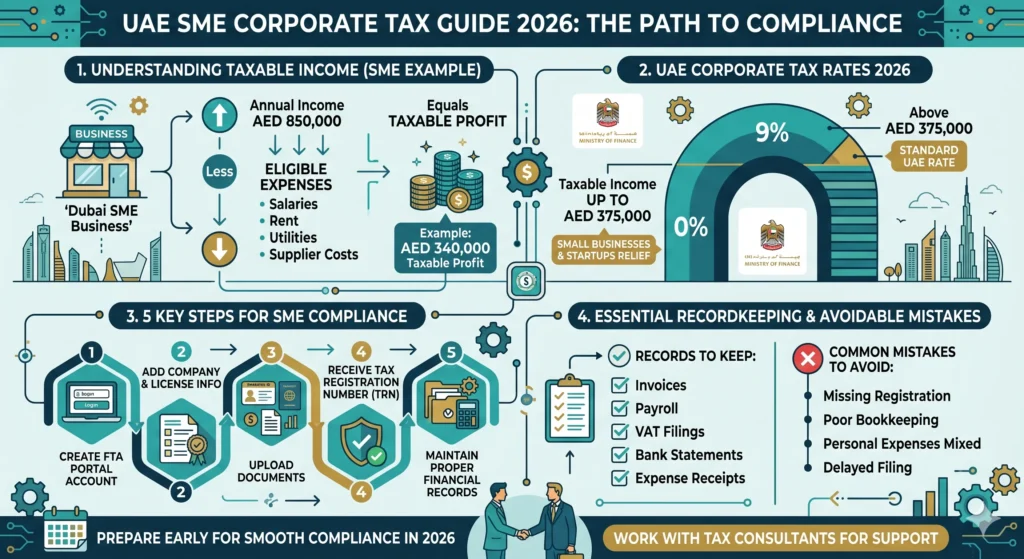
A Dubai-based digital marketing agency earns AED 850,000 annually.
After deducting:
- staff salaries,
- software subscriptions,
- office rent,
- internet expenses,
- and operating costs,
its final taxable profit becomes AED 340,000.
In this case, the business may still fall under the 0% Corporate Tax slab because taxable income remains below AED 375,000.
This is why accurate bookkeeping matters for UAE SMEs.
According to the UAE Ministry of Finance, the standard Corporate Tax rate in the UAE remains 9%, making it one of the lowest business tax rates globally.
Why UAE Introduced Corporate Tax
The UAE introduced Corporate Tax to:
- align with international tax standards,
- strengthen financial transparency,
- support long-term economic growth,
- and maintain the UAE’s position as a global business hub.
At the same time, the UAE continues to offer one of the most business-friendly tax systems globally for SMEs and startups.
According to the UAE Ministry of Economy, SMEs contribute more than 63.5% of the UAE’s non-oil GDP.
This shows how important SMEs are to the UAE economy.
Who Needs to Register for Corporate Tax in UAE?
Many small business owners believe Corporate Tax only affects large corporations. That is incorrect.
Several types of SMEs operating in the UAE may require Corporate Tax registration.
Businesses That Commonly Need Registration
The following businesses may fall under UAE Corporate Tax rules:
- Mainland companies
- Free Zone businesses
- E-commerce stores
- Consultants and freelancers
- Restaurants and cafes
- Marketing agencies
- Trading companies
- Construction businesses
- Real estate service firms
- Startups and professional firms
Businesses That May Qualify for Exemptions
Some entities may qualify for exemptions under UAE Corporate Tax law, including:
- government entities,
- qualifying public benefit organizations,
- certain investment funds,
- and eligible Free Zone income categories.
However, businesses should carefully review their structure before assuming they are exempt.
Any UAE business earning taxable profits above the approved threshold may need Corporate Tax registration with the Federal Tax Authority.
UAE Corporate Tax Rates for SMEs (2026)
The UAE currently applies a two-level Corporate Tax structure.
| Taxable Income | Corporate Tax Rate |
| Up to AED 375,000 | 0% |
| Above AED 375,000 | 9% |
This lower threshold helps startups and small businesses during early growth stages.
Why the 0% Threshold Matters for SMEs
The AED 375,000 threshold gives smaller businesses:
- better cash flow flexibility,
- lower financial pressure,
- and easier business expansion opportunities.
According to the World Bank, lower SME taxation systems can support entrepreneurship and improve business sustainability.
Small Business Relief Under UAE Corporate Tax
The UAE introduced Small Business Relief to reduce compliance pressure for eligible SMEs.
This relief may help smaller companies reduce tax-related administrative work if they meet FTA conditions.
SMEs May Qualify If
- Revenue remains below the approved threshold
- Proper accounting records are maintained
- Business activities are genuine
- Compliance rules are followed correctly
Benefits of Small Business Relief
Eligible SMEs may benefit from:
- reduced filing pressure,
- simplified reporting,
- improved cash flow,
- and lower compliance costs.
Important Limitations Businesses Should Know
Businesses may lose eligibility if they:
- provide incorrect declarations,
- artificially split business activities,
- or misuse related-party structures.
The FTA may review businesses suspected of improper reporting practices.
UAE Corporate Tax Registration Process for SMEs
Corporate Tax registration is completed online through the Federal Tax Authority portal.
Step 1: Create an FTA Account
Businesses must first create an account through the official FTA portal.
FTA Portal:
https://tax.gov.ae/
Step 2: Add Company Information
The business will need to provide:
- trade license details,
- business activity information,
- ownership details,
- and contact information.
Step 3: Upload Required Documents
The FTA may request supporting documents for verification.
Step 4: Receive Tax Registration Number (TRN)
Once approved, the company receives a Corporate Tax Registration Number.
Step 5: Maintain Financial Records
Businesses should continue maintaining proper accounting records for future filings and possible audits.
Documents Required for UAE Corporate Tax Registration
Most SMEs are commonly asked to provide:
- Valid trade license
- Emirates ID
- Passport copy
- Memorandum of Association (MOA)
- Company incorporation certificate
- Business activity details
- Contact information
- Financial statements
Preparing documents in advance usually helps speed up the registration process.
Corporate Tax Filing Requirements for SMEs
After registration, businesses must file Corporate Tax returns annually.
This is where many SMEs face difficulties because financial records are often incomplete or poorly maintained.
When Should SMEs File Corporate Tax Returns?
Corporate Tax returns are generally submitted based on the company’s financial year.
Businesses should monitor:
- filing deadlines,
- taxable income,
- financial statements,
- and recordkeeping obligations carefully.
Financial Records SMEs Should Maintain
The FTA may request:
- invoices,
- payroll records,
- supplier bills,
- expense receipts,
- VAT filings,
- bank statements,
- and accounting reports.
Why Bookkeeping Matters
Good bookkeeping helps businesses:
- calculate taxable income correctly,
- avoid filing mistakes,
- reduce audit risks,
- and prepare accurate financial reports.
According to a report published by QuickBooks, poor cash flow management and weak financial tracking remain among the top reasons small businesses face operational difficulties globally.
UAE Free Zone SME Corporate Tax Rules
Many Free Zone companies assume they automatically qualify for 0% Corporate Tax permanently.
That is not always correct.
Some businesses may continue receiving 0% tax benefits only if they qualify as a Qualifying Free Zone Person (QFZP).
Key Areas Free Zone SMEs Should Understand
- Qualifying income
- Mainland business transactions
- Economic substance requirements
- Transfer pricing rules
- Financial reporting standards
Example
A Sharjah Free Zone company that starts earning non-qualifying mainland income may lose certain 0% tax benefits if compliance conditions are not properly maintained.
Free Zone Compliance Risks
Businesses may lose tax benefits because of:
- incorrect accounting,
- non-qualifying income,
- weak documentation,
- or improper mainland transactions.
Common Corporate Tax Mistakes SMEs Make
Many Corporate Tax penalties happen because businesses delay preparation or maintain weak financial records.
Common Mistakes Include
- Missing registration deadlines
- Poor bookkeeping practices
- Mixing personal and business expenses
- Incorrect taxable income calculations
- Ignoring transfer pricing rules
- Delayed filing submissions
- Missing invoices and receipts
- Assuming Free Zone businesses are automatically exempt
Important Tip for UAE SMEs
Businesses that update accounts monthly usually complete tax filing faster and face fewer compliance issues compared to businesses that only review records at year-end.
UAE Corporate Tax Penalties for Non-Compliance
Failure to comply with UAE Corporate Tax rules may result in administrative penalties from the Federal Tax Authority.
Businesses May Face Penalties For
- Late registration
- Incorrect tax returns
- Delayed filing
- Missing financial records
- Inaccurate reporting
- Failure to maintain documentation
Apart from financial penalties, repeated compliance failures may increase the chances of FTA audits.
Difference Between VAT and Corporate Tax in UAE
Many UAE SMEs confuse VAT with Corporate Tax.
Here is a simple comparison:
| VAT | Corporate Tax |
| Tax on goods and services | Tax on business profits |
| Indirect tax | Direct tax |
| Based on sales | Based on taxable income |
| Usually filed quarterly | Usually filed annually |
Businesses may need compliance for both VAT and Corporate Tax depending on their activities.
How SMEs Can Prepare for Corporate Tax Compliance
Businesses that prepare early usually face fewer filing problems later.
Practical Steps SMEs Should Follow
- Maintain monthly bookkeeping
- Separate business and personal expenses
- Store invoices safely
- Track deductible expenses properly
- Use accounting software
- Monitor taxable income regularly
- Conduct financial reviews
- Work with experienced tax consultants
Real-World Example
A small trading business in Abu Dhabi that maintains organized monthly accounts can usually complete annual tax filing much faster than a company that starts organizing records only before the deadline.
Benefits of Proper Corporate Tax Compliance
Many SMEs initially see Corporate Tax as just another legal process.
But proper compliance can actually support business growth.
Main Benefits
- Reduced penalty risks
- Better financial clarity
- Improved investor confidence
- Easier bank loan approvals
- Stronger business credibility
- More accurate cash flow planning
According to the UAE Ministry of Economy, SMEs represent over 94% of businesses operating in the UAE.
This is one reason why proper SME compliance has become a major focus in the UAE business environment.
Why SMEs Work With Corporate Tax Consultants in UAE
Corporate Tax rules continue to change, especially for SMEs operating in Free Zones and Mainland UAE.
Because of this, many companies work with experienced tax consultants for:
- registration support,
- bookkeeping,
- tax filing,
- compliance reviews,
- audit preparation,
- and financial reporting.
Businesses can also review related services from Expert Edge UAE:
- Corporate Tax Services in Dubai
- Accounting & Bookkeeping Services
- VAT Services in Dubai
- Audit Services in Dubai
Final Thoughts
Corporate Tax is now an important part of running a business in the UAE. SMEs that prepare early usually face fewer compliance problems later.
Good bookkeeping, accurate financial reporting, timely registration, and proper filing can help businesses avoid penalties and maintain smooth operations.
Whether you operate in Dubai, Abu Dhabi, Sharjah, or another Emirate, understanding UAE Corporate Tax rules in 2026 can help your business stay financially organized and compliant.
If your business needs support with Corporate Tax registration, filing, bookkeeping, VAT, or audit preparation, Expert Edge UAE can help your company stay aligned with current FTA regulations.
Frequently Asked Questions
Do SMEs need to pay Corporate Tax in UAE?
Yes. SMEs earning taxable profits above the approved threshold may need to pay Corporate Tax. Even businesses qualifying for 0% tax may still need registration and annual filing.
What is the UAE Corporate Tax threshold for SMEs?
Businesses with taxable income up to AED 375,000 currently benefit from a 0% Corporate Tax rate. Income above this threshold is generally taxed at 9%.
Are Free Zone companies exempt from Corporate Tax?
Not always. Some Free Zone businesses may still qualify for 0% tax on qualifying income if they meet FTA compliance conditions and maintain proper records.
What happens if a business misses Corporate Tax registration?
Late registration may result in penalties, compliance issues, and increased audit attention from the Federal Tax Authority.
Is Corporate Tax different from VAT?
Yes. VAT applies to goods and services, while Corporate Tax applies to business profits after allowable expenses are deducted.
Can startups apply for Small Business Relief?
Eligible startups and SMEs may qualify if they meet the required revenue and compliance conditions under UAE Corporate Tax rules.
What records should SMEs maintain for compliance?
Businesses should maintain:
and financial statements.
invoices,
payroll records,
bank statements,
VAT filings,
supplier bills,
Should SMEs hire Corporate Tax consultants?
Many SMEs work with tax consultants to reduce filing mistakes, maintain accurate financial records, and improve compliance with FTA regulations.