
Are you sure your business is fully compliant with UAE corporate tax rules?
Many business owners in the UAE still ask this question after the new tax system started. A small mistake in registration, accounting, or filing can lead to penalties.
Corporate tax in the UAE applies to business profits above AED 375,000, with a 9% tax rate regulated by the Federal Tax Authority (FTA). Many businesses face penalties because of late registration, wrong accounting records, or misunderstanding free zone rules. Knowing the most common mistakes helps companies stay compliant and avoid financial loss.
Understanding Corporate Tax in the UAE
What Is Corporate Tax in the UAE?
Corporate tax is a direct tax on the net profit of businesses operating in the United Arab Emirates.
The UAE introduced this tax to align with global tax standards and support long-term economic stability.
Key points businesses must know:
- Corporate tax applies to business profits exceeding AED 375,000
- The standard UAE corporate tax rate is 9%
- Profits below AED 375,000 are taxed at 0%
- The system is regulated by the Federal Tax Authority (FTA)
According to the UAE Ministry of Finance (2023), the tax framework was introduced to strengthen transparency and meet global tax compliance standards.
Who Must Pay Corporate Tax?
Corporate tax applies to several business categories operating in the UAE.
Mainland Companies
Businesses registered in the mainland UAE must register and file corporate tax returns if their profits exceed the threshold.
Free Zone Companies
Free zone businesses may still benefit from 0% tax if they qualify as Qualifying Free Zone Persons (QFZP) and meet regulatory conditions.
Foreign Businesses
Foreign companies that operate or earn income in the UAE may also fall under corporate tax rules.
Who must register for corporate tax in the UAE?
Businesses required to register include:
- Mainland companies
- Free zone companies
- foreign entities doing business in the UAE
- individuals conducting licensed commercial activities
Why Corporate Tax Compliance Is Important for UAE Businesses
Following UAE corporate tax law helps businesses avoid several risks.
If companies ignore compliance rules, they may face:
- financial penalties
- tax audits
- legal action
- restrictions on business operations
- damage to company reputation
The Federal Tax Authority monitors registration, filings, and tax records to verify compliance.
Businesses that maintain accurate records and file tax returns on time reduce the risk of penalties.
7 Costly Corporate Tax Mistakes Businesses Must Avoid in 2026
Many UAE companies make simple mistakes that lead to penalties or tax complications. Below are the most common issues.
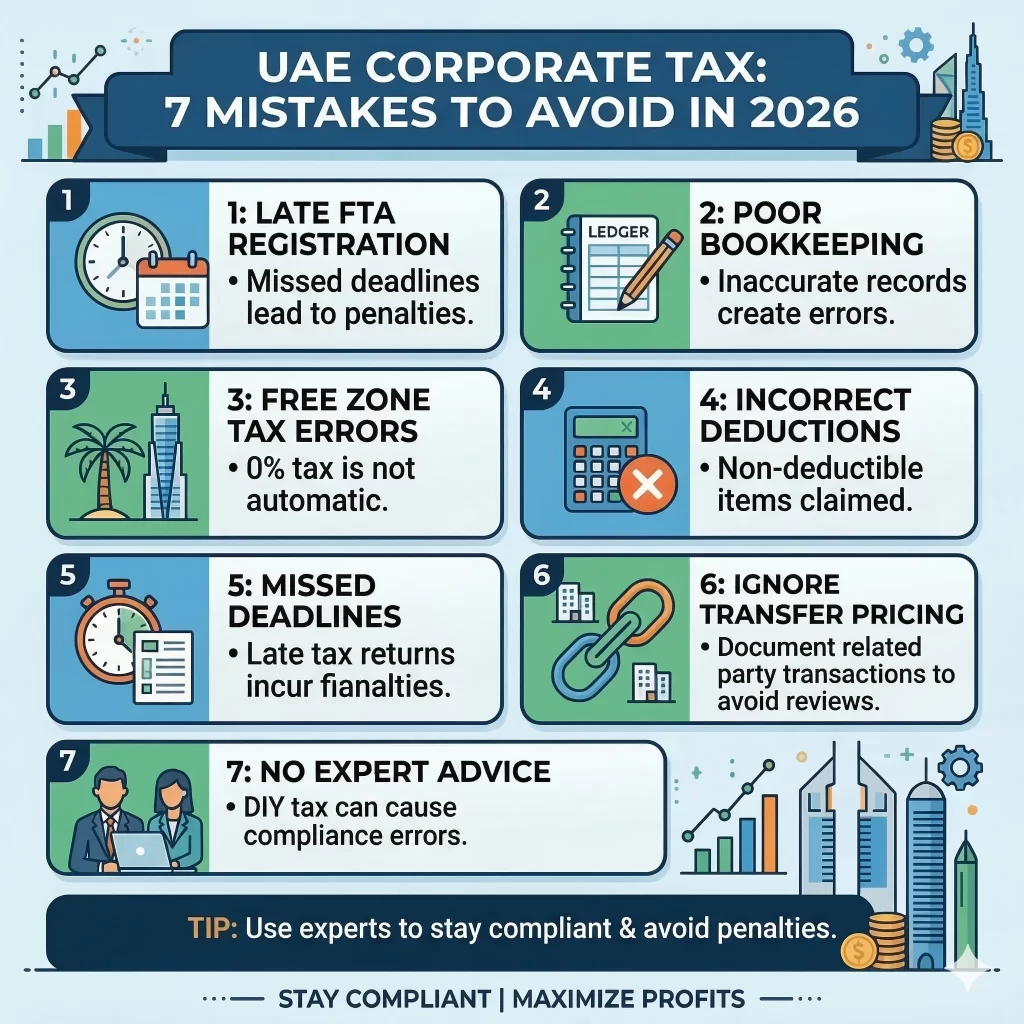
Mistake 1: Not Registering for Corporate Tax on Time
Every eligible business must register with the Federal Tax Authority.
Late registration may lead to penalties.
Businesses should:
- complete corporate tax registration through the FTA portal
- maintain trade license information
- update company financial details
Delaying registration can cause compliance issues even before the first tax filing.
Mistake 2: Poor Accounting and Bookkeeping Practices
Accurate accounting records are necessary for correct tax reporting.
Businesses that fail to maintain proper financial records may face:
- incorrect profit calculations
- inaccurate tax filing
- audit risks
Important accounting records include:
- invoices and receipts
- expense documentation
- bank statements
- financial statements
Businesses often solve this problem by working with professional accounting and bookkeeping services.
Mistake 3: Misunderstanding Free Zone Tax Benefits
Many free zone businesses believe they automatically qualify for 0% corporate tax.
However, companies must meet specific conditions to be classified as Qualifying Free Zone Persons.
Requirements include:
- maintaining economic substance in the free zone
- earning qualifying income
- complying with transfer pricing rules
- filing corporate tax returns
If these rules are not met, the company may be taxed at 9%.
Mistake 4: Incorrect Deduction of Business Expenses
Not all expenses can reduce taxable income.
Allowable deductions usually include:
- business operational costs
- employee salaries
- rent and utilities
- professional service fees
However, certain expenses may not be deductible, such as:
- personal expenses
- fines and penalties
- non-business related costs
Businesses should maintain proper documentation for all deductions.
Mistake 5: Late Corporate Tax Filing
Corporate tax returns must be filed within the deadlines set by the Federal Tax Authority.
Late filing may result in penalties.
Businesses should:
- track financial records regularly
- prepare tax reports before the deadline
- review financial statements
Working with tax advisors helps businesses manage deadlines and avoid compliance problems.
Mistake 6: Ignoring Transfer Pricing Rules
Transfer pricing applies to transactions between related companies.
The UAE corporate tax system requires businesses to follow guidelines aligned with OECD transfer pricing standards.
Companies must:
- document related party transactions
- maintain transfer pricing records
- submit disclosures when required
Ignoring these requirements may trigger tax reviews.
Mistake 7: Not Consulting Corporate Tax Experts
Corporate tax law in the UAE includes several regulatory requirements.
Without professional guidance, businesses may face:
- incorrect tax calculation
- compliance errors
- missed filing deadlines
Working with a corporate tax consultant in the UAE helps businesses manage obligations efficiently.
Callout Tip
Important Tip:
Many penalties occur because companies try to manage tax filings without professional support. Consulting tax experts early helps prevent compliance mistakes.
How Businesses Can Stay Compliant with UAE Corporate Tax Regulations
Companies can reduce tax risks by following simple compliance practices.
Maintain Accurate Financial Records
Keep updated accounting records and financial statements.
Register with the Federal Tax Authority
Businesses must register through the FTA portal before filing tax returns.
Track Profit and Expenses
Proper profit tracking helps calculate taxable income correctly.
Monitor Regulatory Updates
Corporate tax rules may change over time.
Work With Tax Advisors
Professional consultants provide guidance on compliance and tax planning.
How Professional Corporate Tax Consultants Help Businesses Avoid Penalties
Many companies in the UAE rely on experienced tax consultants to manage compliance.
Professional consultants help with:
- corporate tax registration
- tax return filing
- financial documentation
- transfer pricing guidance
- audit preparation
Businesses working with experts can reduce compliance errors and improve financial planning.
Expert Edge UAE supports businesses with corporate tax compliance, accounting support, and regulatory guidance.
Conclusion
Corporate tax compliance has become an important responsibility for businesses operating in the UAE.
Mistakes such as late registration, poor bookkeeping, incorrect deductions, and missed filing deadlines can lead to penalties and regulatory issues.
Businesses that maintain accurate financial records and seek professional tax support can manage their obligations smoothly.
If your company needs help with corporate tax registration, filing, or compliance, working with experienced advisors can make the process much easier.
FAQ’s
1.What is the corporate tax rate in the UAE?
The UAE corporate tax rate is 9% on taxable profits exceeding AED 375,000. Profits below this amount are taxed at 0%. The system is regulated by the Federal Tax Authority.
2. Do free zone companies pay corporate tax?
Free zone companies may qualify for 0% corporate tax if they meet the conditions for Qualifying Free Zone Persons and comply with tax regulations.
3. What happens if a company fails to file corporate tax?
Failure to file corporate tax returns may result in financial penalties, tax audits, and legal action from the Federal Tax Authority.
4. Who should register for corporate tax in the UAE?
Businesses required to register include:
individuals conducting licensed commercial activities
mainland companies
free zone businesses
foreign entities operating in the UAE
5. When did corporate tax start in the UAE?
The UAE corporate tax system became effective for financial years starting on 1 June 2023, according to the UAE Ministry of Finance.
6. Is corporate tax applicable to small businesses?
Small businesses with profits below AED 375,000 are taxed at 0%, but they may still need to register depending on regulatory requirements.