
Are You Planning to Start a Business in Dubai but Unsure Which Setup Option Is Right for You?
If you’re researching Dubai business setup options, you’ve probably noticed something quickly: there is no shortage of information online.
The challenge is that much of it focuses only on getting a trade license.
What many first-time founders discover later is that company formation is only one part of the journey. Banking requirements, visa eligibility, accounting obligations, Corporate Tax compliance, and future expansion plans can all affect whether your business starts smoothly or faces avoidable delays.
Quick Answer
Setting up a company in Dubai typically involves choosing a business activity, selecting a legal structure, deciding between Mainland or Free Zone registration, obtaining a trade license, opening a corporate bank account, and meeting UAE compliance requirements. The right setup depends on your business model, customer base, growth plans, and operational needs.
At Expert Edge, we regularly speak with entrepreneurs who want more than just a business license. They want a setup structure that supports long-term growth, compliance, and operational efficiency.
This guide explains the process in practical terms so you can make informed decisions before investing time and money into company formation.
Why Dubai Continues to Attract Entrepreneurs in 2026
Dubai has spent years building an environment that attracts startups, SMEs, multinational companies, and foreign investors.
For many business owners, Dubai offers three major advantages:
- Access to regional and international markets
- Modern infrastructure and digital services
- Business-friendly regulations
The city also serves as a gateway between Asia, Europe, and Africa, making it attractive for companies involved in trade, logistics, consulting, technology, and professional services.
According to the UAE Ministry of Economy, the country’s focus on economic diversification continues to support growth across non-oil sectors, creating opportunities for new businesses and foreign investment.
For entrepreneurs looking at expansion into the Middle East, Dubai is often one of the first locations considered.
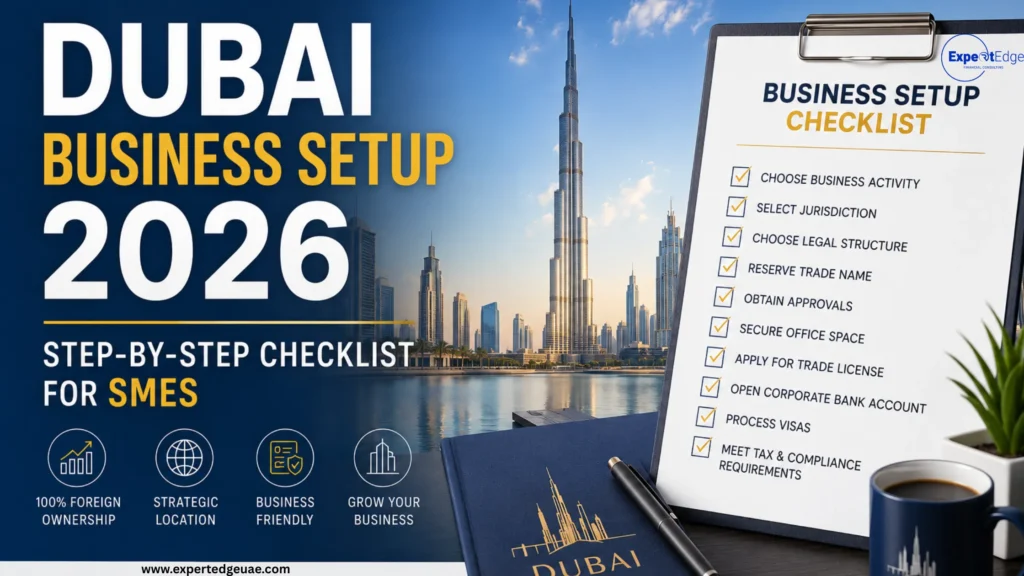
Dubai Business Setup Checklist: A Quick Overview
Before discussing each step in detail, here is a simplified view of the process.
| Steps | Action |
| 1 | Choose your business activity |
| 2 | Decide between Mainland and Free Zone |
| 3 | Select a legal structure |
| 4 | Reserve a trade name |
| 5 | Obtain initial approvals |
| 6 | Secure office space |
| 7 | Apply for a business license |
| 8 | Open a corporate bank account |
| 9 | Process visas and Emirates ID |
| 10 | Meet tax and compliance requirements |
While the process may look straightforward, each decision influences future costs, flexibility, and compliance obligations
Before You Start: What Most New Business Owners Overlook
One pattern appears repeatedly when entrepreneurs begin researching company setup in Dubai.
Most people spend weeks comparing setup packages but very little time thinking about what happens after registration.
Questions such as:
- Will the business need VAT registration later?
- How many employee visas may be required?
- Which banks are likely to support the business model?
- Will the chosen structure allow future expansion?
- What accounting records must be maintained?
often receive attention only after the company has already been established.
A well-planned setup starts by looking beyond the trade license itself.
Step 1: Choose the Right Business Activity
The first major decision is selecting your business activity.
Your chosen activity determines:
- The type of license required
- Regulatory approvals
- Available jurisdictions
- Future business operations
This decision should reflect what the company will actually do rather than what seems easiest to register.
Common Business Activity Categories
Commercial Activities
Commercial licenses generally cover:
- Trading businesses
- Import and export companies
- Retail operations
- Wholesale distribution
Examples include:
- Consumer goods distributors
- General trading companies
- Electronics suppliers
Professional Activities
Professional licenses typically apply to:
- Business consultants
- Marketing agencies
- IT service providers
- Accounting firms
- Training companies
These activities are popular among startups and service-based SMEs.
Industrial Activities
Industrial licenses are often required for:
- Manufacturing businesses
- Production facilities
- Assembly operations
- Industrial workshops
These activities may require additional approvals depending on the nature of production.
Tourism Activities
Tourism-related businesses may include:
- Travel agencies
- Tour operators
- Hospitality services
- Event organizers
Dubai’s tourism sector continues to create opportunities for businesses serving international visitors.
A Practical Example
Imagine two entrepreneurs.
The first wants to launch a digital marketing agency serving businesses in Dubai and Abu Dhabi.
The second plans to import electronic accessories and distribute them throughout the UAE.
Although both are starting companies, their licensing requirements, approvals, and setup structures may differ significantly because their business activities are different.
This is why selecting the correct activity at the beginning is so important.
Step 2: Mainland vs Free Zone – Which Is Better for Your Business?
This is one of the most common questions we hear from business owners.
Unfortunately, there is no universal answer.
The best option depends on how the business intends to operate.
Understanding Mainland Companies
A Mainland company is generally licensed through Dubai’s Department of Economy and Tourism (DET).
This structure is often suitable for businesses that:
- Serve customers across the UAE
- Operate physical offices or retail locations
- Work with government-related projects
- Plan significant local expansion
Advantages of Mainland Setup
Many SMEs choose Mainland registration because it offers:
- Access to the wider UAE market
- Operational flexibility
- Greater expansion opportunities
For companies targeting local clients, this structure is frequently considered.
Understanding Free Zone Companies
Free Zones are designated business areas created to support entrepreneurship, foreign investment, and international business activities.
Popular options include:
- Dubai Multi Commodities Centre (DMCC)
- IFZA Dubai
- Meydan Free Zone
- Dubai Silicon Oasis
- Dubai South
Free Zones often appeal to:
- Consultants
- Technology startups
- E-commerce businesses
- International trading companies
Advantages of Free Zone Setup
Business owners are often attracted by:
- Streamlined registration processes
- Flexible office solutions
- Startup-friendly packages
- International business support
A Real-World Comparison
Let’s consider two common examples.
Example 1: Marketing Agency
A founder launches a digital marketing agency serving companies throughout Dubai.
Most clients are local businesses.
In this situation, a Mainland structure may offer stronger flexibility for local operations and future growth.
Example 2: Software Startup
A SaaS company sells subscriptions to customers in multiple countries.
Its operations are entirely online.
A Free Zone setup may be more suitable because the business primarily serves international markets rather than relying on local physical operations.
Mainland vs Free Zone Comparison
| Feature | Mainland | Free Zone |
| UAE Market Access | Extensive | Depends on business model |
| International Operations | Yes | Yes |
| Startup Popularity | High | High |
| Flexible Office Options | Moderate | High |
| Suitable for Consultants | Yes | Yes |
| Suitable for Trading | Yes | Yes |
The right choice depends less on setup costs and more on how the company plans to operate over the next several years.
Common Mistake: Choosing Based Only on Price
Many entrepreneurs focus heavily on the advertised setup package cost.
While budget matters, price alone should not determine the structure.
A package that looks inexpensive today may require:
- Additional visa costs later
- Activity amendments
- Office upgrades
- Administrative changes
One of the most valuable exercises during company formation is evaluating where the business is likely to be two or three years from now rather than focusing only on the registration fee.
Step 3: Choosing the Right Legal Structure
After selecting the jurisdiction, the next step is determining the legal structure.
The structure affects ownership, liability, compliance requirements, and future growth.
Limited Liability Company (LLC)
The LLC remains one of the most widely used business structures in Dubai.
Many SMEs prefer it because:
- It provides liability protection
- It is widely recognised by clients and institutions
- It supports a broad range of commercial activities
This structure is common among trading businesses, service providers, and growing companies.
Sole Establishment
A Sole Establishment is owned by a single individual.
It is often used by:
- Independent consultants
- Freelancers
- Individual professionals
However, the owner remains responsible for business obligations.
Civil Company
Civil Companies are frequently chosen by licensed professionals such as:
- Engineers
- Architects
- Medical professionals
- Consultants
These structures are designed to support specialised professional services.
Branch Office
Foreign companies looking to establish a presence in Dubai may consider opening a branch office.
This option can allow international businesses to expand operations while maintaining their parent company identity.
What Comes Next?
By this stage, you should have:
Identified your business activity
Chosen Mainland or Free Zone registration
Selected an appropriate legal structure
The next steps involve:
- Trade name reservation
- Initial approvals
- Office space requirements
- Trade license issuance
- Corporate banking
- Investor visas
- Corporate Tax and VAT considerations
These stages often determine how quickly a company becomes operational.
Step 4: Reserve Your Trade Name
Your trade name is more than a registration requirement. It becomes part of your brand identity, marketing efforts, legal documents, invoices, and customer communications.
Many founders choose a name based purely on preference, only to discover later that it does not meet regulatory requirements or is already registered.
What Makes a Good Trade Name?
A strong trade name should:
- Reflect the nature of the business
- Be easy to remember
- Be easy to pronounce
- Support future branding efforts
- Comply with UAE naming regulations
Examples
Horizon Business Consultancy LLC
GulfTech Solutions
Vertex Trading LLC
These names clearly indicate a business purpose while remaining professional and scalable.
Common Trade Name Mistakes
During business setup consultations, we often see founders make one of the following mistakes:
Choosing a Name That Is Too Limiting
For example:
A company begins as a social media agency and registers a highly specific name.
Three years later, the business expands into branding, web development, and consulting. The original name no longer reflects the company’s services.
Copying Existing Brands
A name that resembles an established trademark can create registration challenges and legal concerns.
Ignoring Future Expansion
A business name should still make sense if the company grows into new services or markets.
For many SMEs, selecting the right trade name at the beginning avoids unnecessary rebranding expenses later.
Step 5: Obtain Initial Approvals
Once your business activity and trade name are confirmed, the next stage involves obtaining preliminary approvals.
These approvals indicate that the relevant authorities have no objection to the proposed business activity.
Depending on the industry, additional approvals may also be required.
Examples of Businesses That May Need Extra Approvals
Healthcare
Healthcare-related businesses may require permissions from relevant health authorities.
Examples include:
- Medical clinics
- Healthcare consultancies
- Wellness centres
Education
Training institutes and educational organisations may require additional approvals before licensing.
Financial Services
Financial activities often have specific regulatory requirements that go beyond standard business licensing.
Why This Step Matters
Many entrepreneurs underestimate the importance of approvals.
In reality, identifying approval requirements early can prevent significant delays later in the process.
A business that requires regulatory permissions may follow a different timeline than a standard consulting company.
This is one reason why two businesses with similar setup costs can have very different registration experiences.
Step 6: Secure Office Space
One of the biggest misconceptions about Dubai company formation is that every business requires a large physical office.
In reality, office requirements vary considerably depending on:
- Business activity
- Jurisdiction
- Number of visas required
- Operational needs
The right solution depends on where the business is today and where it expects to be in the future.
Flexi Desk Solutions
Flexi desks are popular among:
- Startup founders
- Solo consultants
- Freelancers
- Small service businesses
Benefits often include:
- Lower operational costs
- Professional business address
- Eligibility for visa allocation
For businesses in their early stages, this can be a practical starting point.
Shared Office Solutions
Shared workspaces offer a balance between flexibility and professionalism.
They are often suitable for:
- Small teams
- Growing startups
- Service providers
Benefits may include:
- Meeting room access
- Administrative support
- Networking opportunities
Dedicated Office Space
Established businesses often require dedicated offices.
This option may be suitable for:
- Trading companies
- Businesses with multiple employees
- Client-facing organisations
A dedicated office can support growth, team collaboration, and professional credibility.
A Practical Growth Perspective
One issue we regularly see is founders selecting office solutions based solely on current costs.
The better approach is to consider expected growth.
For example:
A consulting firm with one founder today may hire three employees within the next twelve months.
Selecting an office solution that supports future visa requirements and expansion can reduce administrative changes later.
Step 7: Apply for Your Trade License
After approvals and office arrangements are completed, the licensing authority can issue the trade license.
This document officially allows the company to operate.
Many entrepreneurs view this as the finish line.
In reality, it is often the beginning.
Once the trade license is issued, several important operational steps still remain.
Common License Categories
Commercial License
Typically used for:
- Trading businesses
- Import and export companies
- Retail operations
Professional License
Common among:
- Consultants
- Marketing agencies
- IT service providers
- Accounting firms
Industrial License
Usually required for:
- Manufacturing activities
- Production facilities
- Industrial operations
The selected business activity determines which license category is appropriate.
The Part Many Founders Do Not Expect
Receiving a trade license feels like a major milestone.
However, many entrepreneurs are surprised to learn that some of the most important steps occur after licensing.
These include:
- Corporate banking
- Visa processing
- Accounting setup
- Tax registration
- Compliance management
This is often where businesses experience delays if preparation has not been done in advance.
Opening a Corporate Bank Account: The Stage That Often Takes Longer Than Expected
One of the biggest surprises for first-time business owners is corporate banking.
Many assume that once the trade license is issued, opening a bank account will be quick.
In practice, banks conduct their own compliance reviews before approving new corporate accounts.
Why Banks Conduct Additional Reviews
Financial institutions must comply with regulations relating to:
- Anti-money laundering requirements
- Know Your Customer (KYC) procedures
- Risk management policies
- International compliance standards
Because of this, banks assess far more than the trade license itself.
Information Banks Commonly Review
Banks may review:
- Business activities
- Ownership structure
- Expected transactions
- Geographic markets
- Source of funds
- Business plans
The process is designed to understand how the company intends to operate.
Documentation Often Requested
Although requirements vary by bank, common documents may include:
- Trade License
- Shareholder passport copies
- Company formation documents
- Office lease agreements
- Business profile
- Proof of business activities
Expert Edge Observation
One misconception we regularly encounter is the belief that corporate banking is merely an administrative step.
In reality, banking preparation should begin during the company formation stage.
Businesses that prepare documentation early often experience smoother account opening processes than those that wait until after licensing.
Step 8: Apply for Investor and Employee Visas
Dubai’s business ecosystem attracts entrepreneurs from around the world, making residency options an important consideration.
Following company formation, eligible businesses can generally apply for:
- Investor Visas
- Partner Visas
- Employee Visas
- Family Sponsorship Visas
Typical Visa Process
The process usually includes:
1. Entry Permit (Where Applicable)
Depending on the applicant’s circumstances, an entry permit may be required.
2. Medical Examination
Applicants complete a medical fitness assessment.
3. Emirates ID Registration
Biometric information is collected as part of the Emirates ID process.
4. Visa Approval
After successful completion of the required steps, residency status can be issued.
Visa Allocation Considerations
The number of visas available often depends on:
- Jurisdiction rules
- Office size
- Business activity
- Licensing authority requirements
This is another reason why choosing the right setup structure early is important.
What Successful Founders Usually Do Differently
After helping many SMEs through the setup process, certain patterns become clear.
The founders who experience the smoothest launches typically:
Plan beyond the trade license
Consider future hiring needs
Understand compliance obligations early
Set up bookkeeping systems from the beginning
Prepare banking documentation before registration is completed
Think about long-term growth rather than short-term registration costs
These steps may seem simple, but they can significantly reduce operational challenges during the first year of business.
Preparing for the Next Stage
At this point, your company may already have:
- A registered business activity
- A legal structure
- A trade name
- Regulatory approvals
- Office space
- A trade license
- Banking preparation
- Visa planning
The next phase focuses on something many entrepreneurs overlook until it becomes urgent:
Business setup costs, Corporate Tax, VAT compliance, accounting obligations, and ongoing financial management.
These areas can directly affect profitability, compliance, and long-term business sustainability.

Business Setup Cost in Dubai (2026): What Should SMEs Budget For?
One of the first questions entrepreneurs ask is:
“How much does it actually cost to start a business in Dubai?”
The honest answer is that there is no single price.
The total cost depends on factors such as:
- Business activity
- Mainland or Free Zone registration
- Number of shareholders
- Office requirements
- Visa allocations
- Regulatory approvals
- Industry-specific requirements
This explains why two companies in the same industry can have very different setup costs.
Typical Business Setup Cost Components
When budgeting for company formation, founders should consider several categories of expenses.
| Cost Component | Estimated Range (AED) |
| Trade Name Reservation | 500 – 1,500 |
| Initial Approvals | 500 – 2,000 |
| Business License | 8,000 – 20,000+ |
| Establishment Card | 500 – 2,000 |
| Investor Visa | 3,000 – 7,500 |
| Medical & Emirates ID | 1,000 – 2,000 |
| Office Facilities | Varies |
| Regulatory Approvals | Activity Dependent |
These figures are indicative and can vary depending on jurisdiction and business activity.
Why Comparing Only License Costs Can Be Misleading
A common mistake among first-time founders is comparing only the advertised license price.
For example:
Company A chooses the lowest-cost setup package available.
Company B selects a package that includes sufficient visa allocation, flexible office options, and room for future expansion.
Initially, Company A spends less.
However, after hiring staff, upgrading facilities, and making amendments, total costs may exceed what Company B spends.
The lowest initial cost is not always the lowest long-term cost.
Hidden Costs Many New Business Owners Miss
During company formation discussions, several overlooked expenses appear repeatedly.
These are not necessarily unexpected fees.
They are simply costs founders often fail to include in their original budget.
Accounting and Bookkeeping
Many startups delay bookkeeping until tax deadlines approach.
This often results in:
- Missing financial records
- Poor cash flow visibility
- Additional compliance work
Accounting should be viewed as an operational requirement rather than an optional service.
Corporate Tax Compliance
Businesses subject to UAE Corporate Tax requirements must maintain appropriate records and financial documentation.
Compliance costs can vary depending on:
- Business size
- Transaction volume
- Reporting requirements
Banking Requirements
Certain business models may require additional documentation during account opening.
Professional assistance may sometimes be required to prepare documentation and respond to bank requests.
Visa Expansion Costs
A startup with one founder today may require:
- Additional employee visas
- Larger office facilities
- Operational upgrades
within a relatively short period.
Planning for future workforce growth can help avoid budget surprises.
Corporate Tax in the UAE: What New Businesses Should Know
Since the introduction of Corporate Tax, many entrepreneurs have become more aware of the importance of financial compliance.
One misconception still exists:
“Tax planning can wait until the business becomes profitable.”
In reality, record-keeping should begin from the first day of operation.
What Is UAE Corporate Tax?
Corporate Tax is a federal tax applied to business profits under UAE tax regulations.
The framework is administered by the Federal Tax Authority (FTA).
Businesses should always refer to the latest guidance published by the Federal Tax Authority for current thresholds, exemptions, and filing requirements.
Official Source:
Federal Tax Authority(FTA): https://tax.gov.ae
Why Early Preparation Matters
Founders who establish financial systems early generally find compliance easier later.
Good record-keeping supports:
- Tax reporting
- Financial management
- Cash flow visibility
- Investor confidence
- Business growth planning
Waiting until filing deadlines approach often creates avoidable challenges.
A Practical Example
Consider two consulting businesses that start operations at the same time.
Company A
Maintains organised records from the first month.
Tracks:
- Revenue
- Expenses
- Invoices
- Bank transactions
When compliance deadlines arrive, financial information is readily available.
Company B
Keeps limited records and relies on scattered spreadsheets.
Months later, management must reconstruct financial data manually.
The second approach often consumes more time, creates additional stress, and increases the likelihood of errors.
This example demonstrates why bookkeeping should begin early rather than later.
VAT Registration: Do New Businesses Need It?
Another common question is:
“Do I need VAT registration immediately?”
The answer depends on business activity and revenue thresholds established by the Federal Tax Authority.
What Is VAT?
Value Added Tax (VAT) is a consumption tax currently applied at 5% in the UAE.
Businesses that meet registration requirements must:
- Register with the FTA
- Issue compliant tax invoices
- Maintain records
- Submit VAT returns
Why VAT Planning Matters
Many growing SMEs reach registration thresholds faster than expected.
Businesses that prepare accounting systems early are generally better positioned when registration becomes necessary.
Why Bookkeeping Matters From Day One
One area where many startups struggle is financial visibility.
When founders are focused on sales, marketing, operations, and hiring, bookkeeping often becomes a lower priority.
Unfortunately, this can create problems later.
Benefits of Proper Bookkeeping
Good bookkeeping helps business owners:
- Understand profitability
- Track expenses accurately
- Manage cash flow
- Support tax compliance
- Make informed decisions
It also provides accurate financial information when seeking financing, investment, or expansion opportunities.
What We Often See in Growing SMEs
A pattern frequently emerges.
Businesses that invest in proper financial management early often make better decisions because they have access to reliable financial data.
Businesses without accurate records often rely on assumptions rather than actual performance metrics.
The difference becomes increasingly noticeable as revenue grows.
Popular Free Zones for SMEs in Dubai
Dubai offers multiple Free Zones, each with unique strengths.
The best option depends on business activity, operational requirements, and future plans.
Dubai Multi Commodities Centre (DMCC)
DMCC is one of Dubai’s most established business districts.
It attracts:
- Trading companies
- Commodity businesses
- International investors
Reasons for its popularity include:
- Global reputation
- Strong business ecosystem
- Wide range of licensing options
IFZA Dubai
IFZA continues to attract:
- Startups
- Consultants
- Small businesses
- International entrepreneurs
Many founders consider IFZA because of its flexible company formation options.
Meydan Free Zone
Meydan is often selected by:
- Service-based businesses
- Consultants
- E-commerce companies
Its digital-first approach appeals to many modern entrepreneurs.
Dubai Silicon Oasis
Dubai Silicon Oasis is recognised for supporting:
- Technology businesses
- Software companies
- Innovation-focused ventures
It remains popular among founders operating in the technology sector.
Which Free Zone Is Best?
There is no universal answer.
The best Free Zone depends on:
- Business activity
- Visa requirements
- Operational goals
- Expansion plans
- Budget considerations
A technology startup may prioritise different factors than a trading company or consultancy.
This is why business goals should drive jurisdiction selection rather than promotional offers alone.
A Question Every Founder Should Ask
Before choosing a Free Zone, ask:
“Will this structure still support my business three years from now?”
This simple question often leads to better decisions than focusing exclusively on short-term registration costs.
Many successful SMEs select structures that support future growth rather than only immediate affordability.
Common Business Setup Mistakes We Regularly See
Most business setup challenges do not happen because founders lack ambition or preparation.
They happen because certain decisions made during registration create limitations later.
Over the years, several patterns have appeared repeatedly among new SMEs and startup founders entering the Dubai market.
Learning from these mistakes can save both time and money.
Mistake #1: Choosing the Wrong Business Activity
The business activity selected during registration affects licensing, approvals, banking requirements, and future operations.
Some founders choose an activity simply because it appears easier or cheaper to register.
Months later, they discover that the activity does not fully cover their services.
This often leads to:
- License amendments
- Additional fees
- Administrative delays
A better approach is to select an activity that reflects both current operations and expected future services.
Mistake #2: Focusing Only on the Lowest Setup Cost
Many entrepreneurs compare setup packages the same way they compare mobile phone plans.
The cheapest option often looks attractive.
However, business formation is a long-term decision.
A lower-cost package may not include:
- Adequate visa eligibility
- Expansion flexibility
- Suitable office solutions
- Future operational support
The question should not be:
“What is the cheapest option?”
Instead, ask:
“Which structure supports my business goals over the next three to five years?”
Mistake #3: Delaying Accounting and Financial Record Keeping
One of the most avoidable mistakes is postponing bookkeeping until tax deadlines approach.
Business owners often assume they can organise financial records later.
In practice, this becomes increasingly difficult as transactions increase.
Maintaining accurate records from the beginning helps support:
- Corporate Tax compliance
- VAT obligations
- Cash flow management
- Business decision-making
Mistake #4: Underestimating Corporate Banking Requirements
Many founders expect banking to be completed immediately after receiving a trade license.
Banks conduct independent reviews and may request additional documentation.
Delays often occur because businesses begin preparing banking requirements too late.
Starting this process early usually creates a smoother experience.
Mistake #5: Not Planning for Future Hiring
A business launched by one founder today may have several employees within the next year.
Visa requirements, office facilities, and operational needs often change faster than expected.
Considering future workforce requirements during company formation can help reduce future administrative changes.
Real SME Examples: Choosing the Right Setup Structure
The best business setup structure depends on how the company plans to operate.
Here are several practical examples that reflect situations commonly seen among SMEs.
Example 1: Digital Marketing Agency
Business Model
A founder plans to provide:
- SEO services
- Social media management
- Website development
- Advertising services
Most clients are based within the UAE.
Recommended Approach
A Mainland structure may provide flexibility for serving local businesses and supporting future growth within the UAE market.
Key Consideration
The founder should think beyond registration costs and evaluate long-term client acquisition opportunities.
Example 2: E-Commerce Business
Business Model
An entrepreneur sells products online to customers in multiple countries.
The business does not require a physical retail store.
Recommended Approach
Many e-commerce businesses consider Free Zone options because they support digital business models and international operations.
Key Consideration
Future warehousing and logistics requirements should be considered during setup planning.
Example 3: Management Consultancy
Business Model
A consultant provides advisory services to clients across the GCC region.
Operations are primarily remote.
Recommended Approach
Several Free Zones offer structures that suit consultancy businesses with flexible operational requirements.
Key Consideration
Banking documentation and service agreements should be prepared early.
Example 4: General Trading Company
Business Model
A business imports and distributes products throughout the UAE.
Recommended Approach
Depending on operational goals, both Mainland and trading-focused Free Zone structures may be suitable.
Key Consideration
Supply chain requirements, warehousing needs, and logistics planning should be evaluated before registration.
How Long Does Business Setup Take in Dubai?
One of the most common questions entrepreneurs ask is:
“How quickly can I start operating?”
The answer depends on:
- Business activity
- Jurisdiction
- Regulatory approvals
- Banking requirements
- Visa processing
Some businesses can complete registration relatively quickly, while others require additional approvals.
Typical Business Setup Timeline
| Stage | Estimated Time |
| Business Activity Selection | 1–2 Days |
| Trade Name Reservation | 1–3 Days |
| Initial Approvals | 1–5 Days |
| Office Documentation | 1–5 Days |
| License Issuance | 2–10 Days |
| Corporate Banking | 1–6 Weeks |
| Visa Processing | 1–3 Weeks |
Actual timelines vary based on business requirements and regulatory approvals.
Why Many SMEs Choose Professional Business Setup Support
Company formation involves a series of decisions that can affect business operations for years.
These decisions include:
- Jurisdiction selection
- Licensing requirements
- Banking preparation
- Tax obligations
- Accounting systems
- Visa planning
While some founders prefer to manage the process independently, many seek professional guidance to reduce uncertainty and avoid avoidable mistakes.
What Professional Support Can Help With
Business setup specialists can assist with:
- Business activity selection
- Jurisdiction evaluation
- Documentation preparation
- Licensing procedures
- Compliance planning
- Financial setup considerations
This allows entrepreneurs to spend more time focusing on customers, operations, and growth.
Why Financial Planning Matters Just as Much as Company Formation
One misconception that exists among new entrepreneurs is that registration is the most important part of launching a company.
Registration is important.
However, long-term success often depends on what happens after the license is issued.
Businesses that establish proper systems early are generally better positioned for growth.
These systems include:
- Accounting processes
- Financial reporting
- Cash flow management
- Tax compliance
- Operational planning
A strong foundation can support better decision-making as the business expands.
Why Businesses Work With Expert Edge
At Expert Edge, we understand that business setup is not simply an administrative process.
Every decision made during company formation can influence:
- Future compliance obligations
- Financial management
- Banking relationships
- Growth opportunities
Our team works with entrepreneurs, startups, and SMEs that want clarity throughout the setup journey.
We assist businesses with:
- Business advisory services
- Accounting and bookkeeping support
- Corporate Tax guidance
- VAT consultancy
- Financial reporting
- Compliance assistance
Our focus is helping business owners build a strong operational foundation rather than simply obtaining a trade license.
Final Thoughts
Dubai remains one of the most attractive destinations for entrepreneurs, startups, and growing SMEs.
The city offers access to international markets, strong infrastructure, business-friendly regulations, and opportunities across a wide range of industries.
However, successful company formation involves more than obtaining a trade license.
Choosing the right business activity, selecting an appropriate jurisdiction, preparing for banking requirements, maintaining financial records, and understanding compliance obligations all contribute to long-term business success.
Before registering your company, take time to evaluate both your current needs and your future growth plans.
A well-planned setup today can help avoid unnecessary costs, delays, and operational challenges tomorrow.
Ready to Start Your Dubai Business Setup Journey?
If you are planning to start, expand, or restructure a business in Dubai, Expert Edge can help you make informed decisions at every stage.
Whether you need guidance on company formation, bookkeeping, VAT, Corporate Tax, or financial compliance, our team can help you build a stronger foundation for growth.
Frequently Asked Questions
1. Is Dubai a good place to start a business in 2026?
Yes. Dubai continues to attract entrepreneurs due to its strategic location, business-friendly regulations, advanced infrastructure, and access to international markets.
2. Can foreigners own 100% of a company in Dubai?
Many business activities now allow 100% foreign ownership in both Mainland and Free Zone jurisdictions, subject to current UAE regulations.
3. What is the average cost of setting up a company in Dubai?
Costs vary depending on the business activity, jurisdiction, office requirements, and visa needs. Many SMEs spend between AED 12,000 and AED 50,000 or more during the initial setup stage.
4. Which is better: Mainland or Free Zone?
The answer depends on your business model. Mainland companies are often chosen for broader UAE market access, while Free Zones are popular among consultants, startups, and internationally focused businesses.
5. How long does company formation take in Dubai?
Many businesses can obtain a trade license within days, although banking approvals and industry-specific permissions may extend the overall timeline.
6. Do I need a local sponsor to start a business in Dubai?
For many activities, foreign investors can now own businesses fully without requiring a traditional local sponsor. Requirements vary depending on the business activity and jurisdiction.
7. When should I think about Corporate Tax compliance?
Corporate Tax planning should begin from the first day of operations. Maintaining accurate financial records early can make future compliance much easier.
8. Why is bookkeeping important for new businesses?
Bookkeeping provides visibility into revenue, expenses, profitability, and cash flow. It also supports tax compliance and business planning.

Helpful checklist, especially for SMEs new to the process. I’ve found InZone UAE useful for getting a clearer picture of the setup steps and requirements- worth checking out.